CloudTalk Alternatives at a Glance: What You Need to Know
If you're reading this, you're probably already on CloudTalk, or seriously weighing it, and something pushed you to see what else is out there. Maybe support took too long to answer calls or tickets. Maybe the add-on costs crept up. Maybe an integration you needed just didn't click into place.
CloudTalk is a cloud phone system built for sales and support teams and call centers. It lets companies make and receive calls from any device, no traditional phone systems or landlines required, and its pricing starts at $25 per user per month. It's a solid product. But it isn't right for everyone, and by 2026 the market offers plenty of capable CloudTalk alternatives, from AI-powered calling platforms to full unified communications suites and ticket-based support tools.
Key takeaways (TL;DR):
- CloudTalk handles call center operations, international calling, and CRM-connected calling well. Users still flag slow support, limited customization, and add-on costs that creep up.
- The right CloudTalk alternative depends entirely on your use case. Sales dialing, inbound support, an enterprise contact center, and global calling each point to a different winner.
- For support teams, HelpDesk.com leads. For CRM-integrated calling, it's Aircall. For AI-powered voice, Dialpad.
- Further down you'll find a scannable comparison table, our evaluation method, and an honest "when CloudTalk wins vs. when the alternative wins" call for each of the 12 picks.
This guide is built for people actively comparing phone systems to switch, so we've cut the fluff and put the decision front and center. Treat it as a practical CloudTalk review as much as a shortlist. Skip to the comparison table.
Quick Comparison Table: Top CloudTalk Alternatives Compared
Here's the high-level CloudTalk alternatives comparison covering all 12 tools, so skimmers can spot their shortlist fast. Start with this quick comparison, then dig into the detail below.
| Provider | Free trial / tier | Best for | Key differentiator | AI features |
|---|---|---|---|---|
| HelpDesk.com | Free trial | Ticket-based support teams | Ticketing + calling context in one workflow | AI-powered response tools |
| Aircall | Free trial | CRM-integrated sales & support | Deep native CRM integrations | Call analytics, transcription |
| Nextiva | Free demo | All-in-one unified comms | UCaaS suite (voice, video, chat, fax) | AI voicemail transcription, analytics |
| CallHippo | See website | Budget & small teams | Affordable virtual numbers | Voicemail transcription |
| 3CX | Free account | Self-hosted, cost-conscious | Self-host / PBX control | CRM-linked call handling |
| Dialpad | Free trial | AI-powered voice & coaching | Real-time transcription & coaching | Conversational AI, summaries |
| JustCall | See website | Outbound sales teams | Predictive/auto dialers + SMS | Sentiment analysis, topic extraction |
| RingCentral | Free trial | Enterprise unified comms | Carrier-grade UCaaS breadth | AI meeting & call tools |
| Talkdesk | Contact sales | AI-driven contact centers | Omnichannel CCaaS + AI agents | Conversational AI, analytics |
| Five9 | Contact sales | Enterprise outbound dialing | Predictive dialing at scale | ML-driven analytics, IVA |
| Ringover | Free trial | International & global teams | Broad international coverage | Call transcription |
| 8x8 | Free trial | Voice + video + contact center | UCaaS and CCaaS combined | AI analytics, transcription |
Pricing changes often, so always confirm current plans on each provider's site before you commit. The free trial and tier availability noted above reflects what each vendor generally offers.
How We Evaluated These CloudTalk Alternatives
We didn't just pull a list of names. Each cloud phone system was assessed against the criteria that actually matter when you're replacing a business phone system:
- Pricing transparency. How clear the entry plans and add-ons are, whether plans start at a predictable rate, and how costs scale by user month.
- AI capabilities such as transcription, sentiment analysis, live coaching, AI agents, and AI generated call summaries.
- Call quality and reliability, meaning voice clarity and the uptime commitments vendors publish.
- Integrations, including the depth of native CRM and helpdesk connections like Salesforce and HubSpot.
- Ease of setup and learning curve, or how fast a team can get productive.
- Customer support quality and responsiveness, since this is a recurring CloudTalk complaint.
- Security and compliance, covering GDPR, HIPAA readiness, encryption, and data residency.
- Real user reviews, meaning the recurring themes in G2 and Capterra feedback, including the weaknesses users repeatedly cite.
We also kept a "when CloudTalk wins" lens throughout. No single tool is best for everyone, and pretending otherwise wouldn't help you make a confident call.
What Is CloudTalk? A Balanced Overview
CloudTalk is a cloud based phone system that provides business communication tools for sales and support teams and call centers. It lets companies make and receive calls from any location on any device without relying on traditional phone systems. The aim is to improve business communication and collaboration, simplify customer support, and lift the overall customer experience.
Its core feature set covers call recording, call routing, IVR, CRM integration, real-time analytics, and workforce management, with pricing that starts at $25 per user per month. CloudTalk is meant to be easy to use and scalable, so it fits businesses of every size, from small teams making their first move to the cloud to established call centers.
CloudTalk's Strengths: When CloudTalk Wins
Before we get into alternatives, it's worth being fair about what CloudTalk does well.
- International calling. CloudTalk is well regarded for helping teams set up local and international numbers, which genuinely helps companies operating across borders.
- Ease of use. The platform is broadly intuitive, so most teams get up and running without a steep onboarding process.
- Call center features. Smart call routing, IVR, call recording, and real-time analytics give inbound and blended teams the operational tools they need.
- CRM integration. Native connections let agents work with customer context right alongside the call.
So CloudTalk wins when you want a straightforward, call-center-ready cloud phone system with international reach, and you don't need heavy customization or a deep AI layer. The alternatives below matter most when your priorities fall outside that sweet spot.
Why Businesses Look for CloudTalk Alternatives
Businesses look for CloudTalk alternatives for several reasons: more advanced features, better pricing, and improved support. Here's how those motivations map to recurring themes in user reviews on G2 and Capterra.
- Support issues. CloudTalk's customer support draws mixed reviews, and users note that getting timely, effective phone support can be difficult. Its support rating is notably low compared with other aspects of the software.
- Limited customization. Next to on-premise solutions, the platform can feel constrained. It's generally easy to use, but some users find advanced features or custom setups less intuitive.
- Compliance concerns. Companies in regulated industries may run into challenges, since data privacy and security requirements vary by region.
- Cost considerations. CloudTalk can save money versus traditional phone systems, but monthly fees plus add-ons add up over time. Watch for hidden costs as you scale.
- Integration challenges. Connecting CloudTalk to existing CRM or helpdesk software can be complex and slow. Users specifically report that integrating with HubSpot can be clunky and far from straightforward.
If any of these resonate, the good news is that the alternatives below tackle them from different angles.
The 12 Best CloudTalk Alternatives & Competitors in 2026
We've gone beyond a short list to cover the tools that come up most often in real buyer research, including ticketing platforms, sales dialers, UCaaS suites, and enterprise contact centers. These are the CloudTalk alternatives buyers are actually comparing. Each review follows the same shape: what it is, key features, pros, best-for, a pricing note, and a plain "when CloudTalk wins vs. when this alternative wins" verdict.
1. HelpDesk.com: Best for Ticket-Based Customer Support Teams
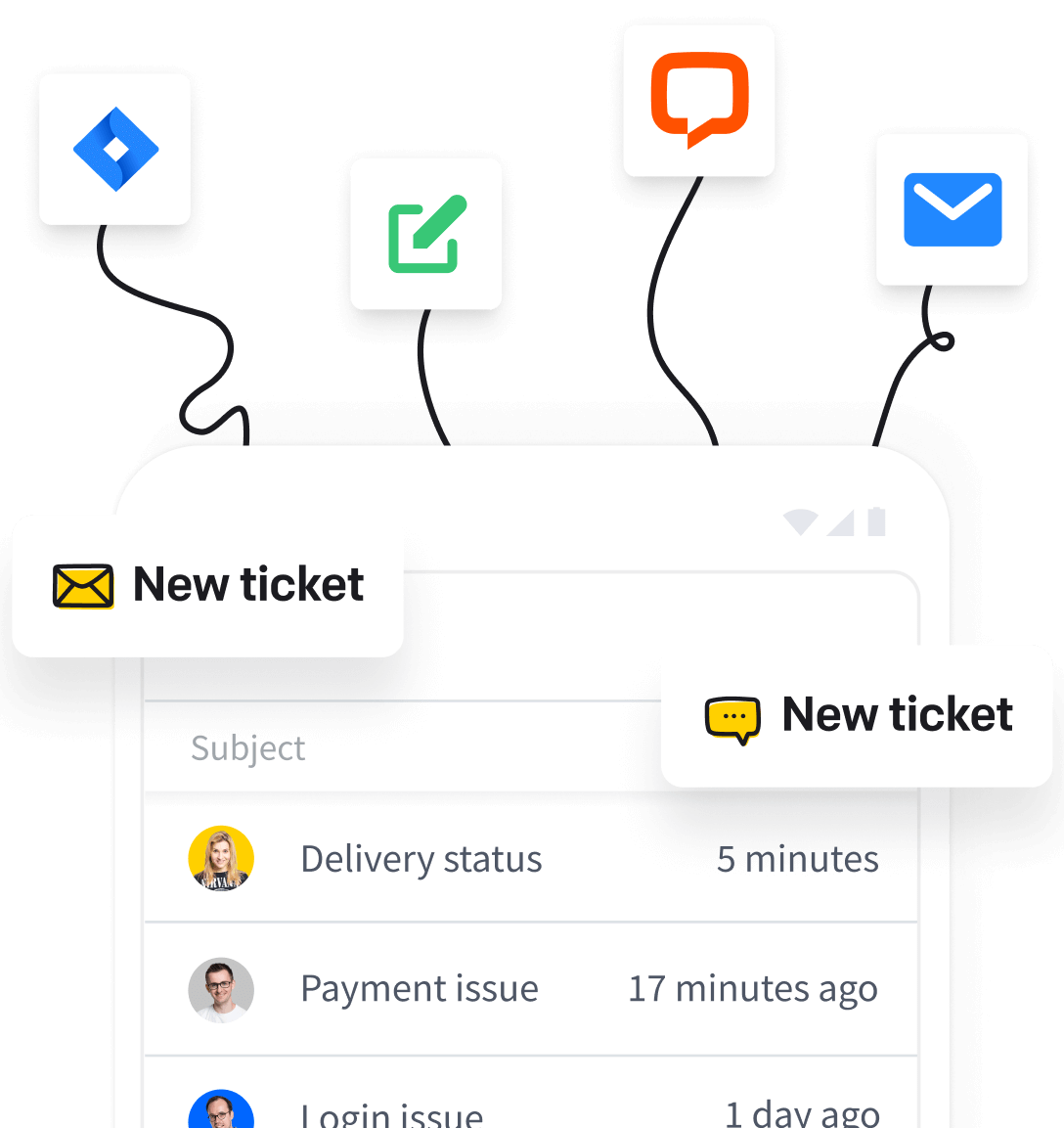
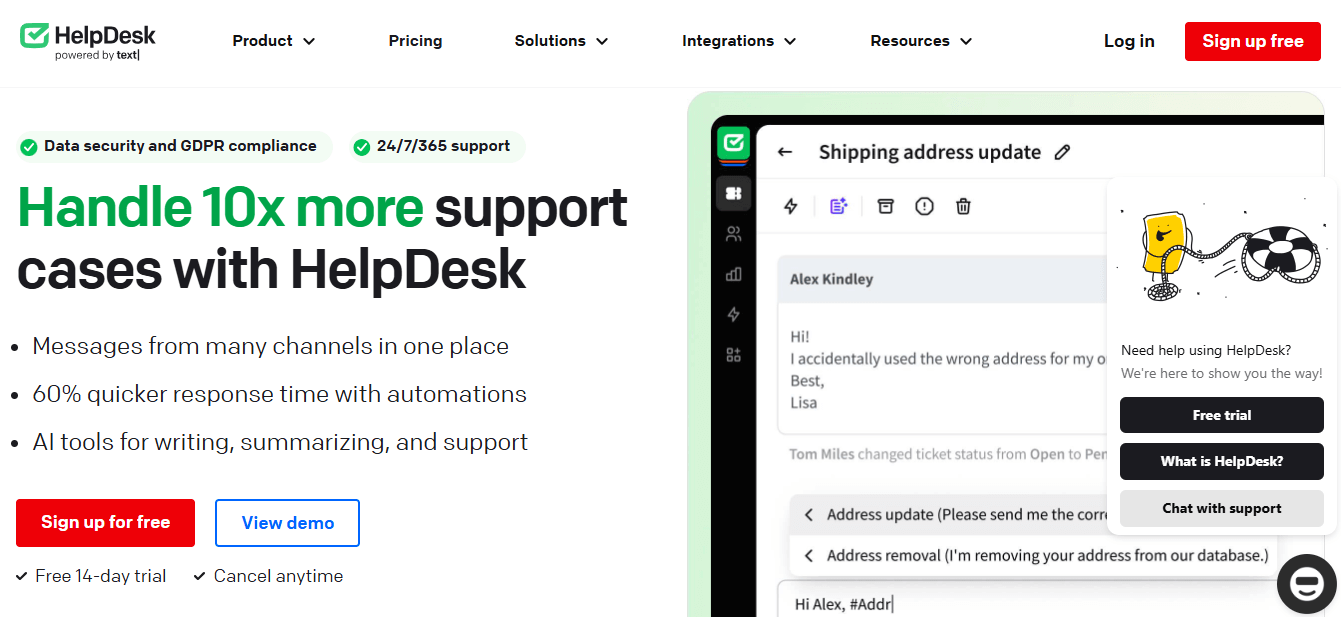
HelpDesk.com is customer service software for delivering personalized support, and it's more than just a phone system replacement. Instead of voice, it centers on ticket management, turning inquiries from multiple channels into organized, trackable tickets your support teams can resolve quickly. You get AI-powered tools, intuitive workflows, and customizable reporting. Its ticketing system automates workflows, routing, and ticket summaries so teams spend less time on manual triage.
The interface is easy to use, it connects natively with LiveChat and tools like Shopify and HubSpot, an AI agent that resolves routine questions is built in, and customer support is available 24/7. Multichannel support keeps customer conversations in one place, and customizable workflows help teams keep response times low and customer satisfaction high. It's best for support teams that live in tickets and want AI-assisted customer communication across channels. There's a 14-day free trial with no credit card required, and pricing is transparent and per user, so you can test the workflow before committing.
CloudTalk wins here if your primary need is voice, a phone system for a calling-heavy team or call center. HelpDesk.com wins when your support runs on written inquiries and tickets, and you want AI tools plus a tightly integrated ecosystem to manage and resolve issues. Many teams pair a phone tool with HelpDesk.com instead of choosing one over the other, since collaboration across teams improves response times and efficiency.
Try HelpDesk.com!2. Aircall: Best for CRM-Integrated Sales & Support Calling
Aircall is a cloud phone system built for businesses that want to sharpen customer interactions. It's known for pairing solid telephony with deep integrations into the tools sales and support teams already use: call distribution, call recording, call analytics, and native CRM connections for smooth communication and data management. It offers over 100 one-click integrations with CRMs, plus call monitoring features like listen, whisper, and barge so managers can coach reps on live customer calls. Add customizable call workflows and real-time analytics for tracking performance, and it's a natural home for teams that want their phone system woven directly into their CRM. Aircall's Essentials plan starts at $30 per user per month with a three-license minimum, and there's a free trial. One caveat: its AI features are currently limited to English and French.
Aircall vs. CloudTalk is one of the most common head-to-head matchups, and the two are genuinely close. CloudTalk wins on international number setup and call-center-specific tooling. Aircall wins when CRM integration quality and customizable workflows top your list, especially if CloudTalk's HubSpot connection felt clunky. If your day revolves around your CRM, Aircall is the more natural fit.
3. Nextiva: Best for All-in-One Unified Communications
Nextiva is a unified communications platform that bundles several services into one. It's a true unified communications play rather than a voice-only tool, covering VoIP calling, virtual faxing, team messaging, and analytics reporting, plus video conferencing and CRM integrations. It supports over 30 turnkey integrations, including Microsoft Teams, and includes AI voicemail transcription in all plans. The interface is user-friendly, the feature set is robust, and support is reliable: Nextiva offers 24/7 phone support on all plans and guarantees 99.999% uptime, an SLA that equates to roughly five minutes of downtime a year. It suits businesses that want a single UCaaS suite for voice, video, chat, and more. Nextiva's pricing starts at $23 per user per month, with a free demo available and a Business plan tier for growing teams.
CloudTalk vs. Nextiva comes down to focus. CloudTalk wins if you specifically want call center features and international calling without the broader UC layer. Nextiva wins when you want to consolidate voice, video meetings, messaging, and faxing into one platform with dependable round-the-clock support, a common reason teams outgrow a voice-only tool.
4. CallHippo: Best Budget-Friendly Virtual Phone System
CallHippo is a virtual phone system provider with cloud-based solutions for businesses of any size. The appeal is simple: an affordable way to make and answer calls from anywhere, with virtual numbers, call forwarding, call recording, and voicemail transcription. Teams get more efficiency, better customer service, and real cost savings. It fits small teams, budget-conscious buyers, and remote teams that need core calling without paying for an enterprise suite. Check CallHippo's pricing page for current tiers.
CloudTalk wins when you need richer contact center capabilities and deeper call analytics. CallHippo wins when affordability and simplicity come first. It's one of the better CloudTalk alternatives for home offices and lean small teams that just need reliable virtual numbers and forwarding.
5. 3CX: Best for Self-Hosted & Cost-Conscious Businesses
3CX is a software-based private branch exchange (PBX) that lets businesses make and receive calls over the internet. What sets it apart is control over how and where you deploy it. Installation is easy, management runs through a web-based interface, and you get softphone apps, video meetings and web conferencing, and integration with popular CRM systems. It works with popular VoIP providers and runs anywhere you have an internet connection. It's cost-effective, easy to use, and plays well with a wide range of third-party apps. Best for businesses that want control over their phone system and low ongoing costs, including those comfortable self-hosting. 3CX offers a free account, with paid options on its pricing page.
CloudTalk wins when you want a fully managed, hands-off cloud service with call-center tooling built in. 3CX wins when cost control and flexibility matter most. Its free tier and self-hosting make it one of the stronger VoIP choices for small businesses that want to own more of the stack.
6. Dialpad: Best for AI-Powered Voice & Real-Time Coaching
Dialpad is a cloud communications platform built around conversational AI, made for teams that want intelligence layered onto every call. It includes real time call transcription, live agent coaching, AI generated call summaries, and sentiment analysis that shows how conversations are going as they happen, with real-time transcription and AI features included in all plans. That combination cuts manual note-taking, lets managers coach reps in the moment, and gives leaders visibility into call sentiment and outcomes. It's the pick for AI-first sales and support teams that want automation and coaching baked into calling. Dialpad typically offers a free trial; check its site for plan details.
CloudTalk wins if you want a straightforward call-center cloud phone system without a deep AI layer. Dialpad wins when AI transcription, real-time coaching, and call summaries sit at the center of how you run your team. It's the clearest answer to which alternative offers the strongest AI features and conversation intelligence.
7. JustCall: Best for Sales Teams & Outbound Dialing
JustCall is a calling and SMS platform aimed at sales teams that make a high volume of outbound calls. Rather than trying to be an all-purpose phone system, it leans into dialer efficiency, with predictive and auto dialers, SMS, cold-calling workflows, and AI tools to support reps. It operates in 90+ countries with local numbers available, supports integrations with major CRM platforms (its HubSpot integration scores 4/5 on the HubSpot Marketplace), and offers AI features like sentiment analysis and call topic extraction. It's built for speed and volume: automated dialing keeps SDRs in live conversations instead of punching numbers by hand, and SMS keeps outreach multi-channel. Best for outbound sales teams, SDRs, and anyone whose day is dominated by cold calling. JustCall's entry-level pricing starts at $39 per user per month; see its website for current plans.
This one comes down to the difference between a cloud phone system and a sales dialer. CloudTalk wins as the broader business phone platform. JustCall wins when your core need is aggressive outbound dialing with predictive and auto-dialer speed and cold-calling workflows.
8. RingCentral: Best for Enterprise Unified Communications
RingCentral is a well-established unified communications provider offering voice, video, messaging, and more across many channels, built for larger organizations. Its UCaaS breadth includes video meetings, SMS, team chat, and over 500 native integrations with business software, all backed by carrier-grade reliability. That scale makes it a dependable backbone for distributed organizations, and its integration ecosystem is extensive. Best for mid-market and enterprise teams that want one platform for all business communications, from a starter tier up to a Business plan and beyond. RingCentral typically offers a free trial; confirm current tiers on its site.
CloudTalk wins for focused call-center use and simpler deployments. RingCentral wins when you need enterprise-grade unified communications across many channels, with the reliability and integration depth a large organization demands.
9. Talkdesk: Best for AI-Driven Cloud Contact Centers
Talkdesk is a cloud contact center platform (CCaaS) focused on customer experience at scale, with AI woven throughout. It brings omnichannel contact center capabilities, conversational AI and AI agents, and advanced analytics, including customer journey analytics, for CX operations. Because it's purpose-built for contact centers, its call routing, automation, and analytics run deeper than a general phone system, and its AI can handle or assist on customer interactions. Best for CX-focused enterprise contact centers that want AI-driven automation and omnichannel support. Talkdesk is a contact center solution typically quoted through its sales team with custom pricing.
CloudTalk wins for smaller call centers and teams that want quick setup at a predictable cost. Talkdesk wins when you're running a serious, AI-forward contact center and need advanced analytics, routing, and automation. It's a strong pick for enterprise contact center needs.
10. Five9: Best for Enterprise Outbound & Predictive Dialing
Five9 is an enterprise cloud contact center solution known for high-volume outbound dialing and workforce engagement. It offers predictive dialing, intelligent virtual agents (IVA), workforce management and engagement, and machine-learning-driven call analytics for agent performance, including call scoring. Engineered for scale, its predictive dialing keeps large agent pools productive, and its ML analytics help optimize performance across big teams. Best for large outbound call centers and enterprises running high-volume campaigns. Five9 is a contact center solution typically quoted through its sales team with custom pricing; contact sales for a quote.
CloudTalk wins for small-to-mid teams that want simplicity. Five9 wins when you operate at enterprise scale and need robust predictive dialing plus workforce management to run large outbound operations.
11. Ringover: Best for International & Global Teams
Ringover is a cloud phone system with a strong emphasis on international coverage and simple, transparent calling. You get international numbers and broad calling coverage, call routing, voice and video meetings, and native integrations with common business tools. Its international reach and multi-channel communication make it easy for globally distributed teams to stay connected without juggling multiple providers. Best for global teams that need reliable international calling and coverage across regions. Ringover typically offers a free trial; check its site for plans.
Both tools handle international calling well. CloudTalk wins if you want its specific call center feature depth. Ringover wins when broad international coverage and straightforward global calling are your defining requirement.
12. 8x8: Best for Integrated Voice, Video & Contact Center
8x8 combines unified communications and contact center capabilities in one platform, aimed at organizations that want both under one roof. It pairs UCaaS and CCaaS, so voice, video meetings, and contact center functionality all sit together, with global coverage and a focus on reliability. Consolidating UC and a contact center solution cuts vendor sprawl, and its global footprint and carrier-grade reliability suit distributed organizations. Best for businesses that want voice, video, and a contact center in one integrated platform. 8x8 typically offers a free trial; confirm plans on its site.
CloudTalk wins for a focused, easy-to-adopt cloud phone system. 8x8 wins when you need both unified communications and contact center capabilities together, with global reach and strong reliability commitments.
AI Features & Call Quality Comparison
AI is where the newer platforms genuinely pull ahead. If intelligence factors into your choice, here's how the field shakes out.
- Transcription: Dialpad, Talkdesk, 8x8, Ringover, and Aircall all offer call transcription in some form, and Dialpad is especially known for the real time transcription kind included in every plan. Nextiva includes AI voicemail transcription across its plans.
- Sentiment analysis: Dialpad and Talkdesk stand out for sentiment analysis that shows how a conversation is going, which helps managers step in early. JustCall also offers sentiment analysis alongside call topic extraction.
- Live coaching: Dialpad's real-time coaching is a defining strength, directly relevant if you've wondered whether CloudTalk offers real-time sales coaching.
- AI agents and conversation intelligence: Talkdesk and Five9 lean furthest into automated and virtual agents that can handle or assist on interactions, and their conversation intelligence layers include call scoring and post call surveys for measuring quality.
- Call summaries: Dialpad and other AI-powered tools automate post-call notes and save reps time.
On call quality and reliability, enterprise-grade providers publish uptime commitments, and the strongest platforms target very high availability. Nextiva, for instance, backs a 99.999% uptime SLA. Some vendors advertise SLAs in the 99.9%+ range, up to five-nines for enterprise tiers. If uptime is business-critical, ask each vendor for its published SLA in writing rather than trusting marketing copy. Voice quality across all these tools depends heavily on your own internet connection and device setup. Users report occasional dips when bandwidth is tight, so test with a trial before rolling it out to a whole team.
Integrations & Ecosystem Comparison
Integrations are one of the top reasons teams leave CloudTalk, since users specifically cite that connecting to systems like HubSpot can be clunky. CRM integrations streamline workflows in customer support, so it pays to weigh them carefully. Here's how to think about it.
- CRM depth (Salesforce, HubSpot): Aircall is widely recognized for deep, native CRM integrations, with over 100 one-click connections, which makes it a natural answer if you want calling that lives inside Salesforce or HubSpot. RingCentral (500+ native integrations) and 8x8 also carry broad integration catalogs, and JustCall supports major CRM platforms too.
- Helpdesk ecosystem: HelpDesk.com integrates tightly with LiveChat and ships with its own AI agent, so support-focused teams get a connected stack rather than a bolt-on.
- Setup and learning curve: 3CX and CallHippo are known for fast, simple setup, while enterprise platforms like Five9 and Talkdesk carry a steeper learning curve in exchange for greater power.
The rule of thumb: the more central your CRM is to daily work, the more you should weigh native integration quality over raw feature counts.
Security & Compliance Considerations
For regulated industries, security can be the deciding factor, and it's one reason some teams look beyond CloudTalk, where compliance can vary by region.
When evaluating any alternative, confirm:
- GDPR compliance for handling EU customer data.
- HIPAA readiness if you operate in healthcare or handle protected health information.
- Data residency, meaning where your call recordings and customer data are physically stored, which matters for many regional regulations.
- Encryption for data in transit and at rest.
- Uptime SLA commitments backed in the contract, not just advertised.
Enterprise-focused platforms like RingCentral, 8x8, Talkdesk, and Five9 generally publish detailed compliance documentation, because their customers require it. Always request the specifics for your jurisdiction and industry before signing. De-risking the choice upfront is far cheaper than migrating twice.
How to Choose the Right CloudTalk Alternative
With a dozen options, the decision gets easier once you answer a few questions in order.
- Define your primary use case. Are you doing outbound sales, inbound support, running a full contact center, or handling ticket-based written support? This alone narrows the field dramatically.
- Understand cloud phone vs. sales dialer. A cloud phone system like CloudTalk, Aircall, or Nextiva handles two-way business calling broadly. A sales dialer like JustCall optimizes for high-volume outbound dialing. Don't buy a dialer if you mostly answer inbound calls, and don't do the reverse either.
- Size your team and budget. Small teams and home offices lean toward CallHippo or 3CX; enterprises lean toward RingCentral, Talkdesk, Five9, or 8x8. Compare where plans start against higher tiers and higher price point options, and factor in add-on costs so you avoid CloudTalk-style surprises.
- Rank your AI needs. If real time transcription, coaching, and summaries matter, prioritize Dialpad or Talkdesk.
- Map your integration requirements. If Salesforce or HubSpot is your hub, weigh native integration quality heavily. Aircall is a strong fit here.
- Plan number porting. In most cases you can keep your existing phone numbers when switching providers through porting. Confirm the process, timeline, and any fees with your chosen vendor before you cancel CloudTalk.
- Use the free trial. Nearly every tool here offers a free trial, tier, or demo. Test call quality and workflows with real users before committing.
Our Recommendation by Use Case
Here's the shortest path to a decision, mapped to who you are.
- Best overall for support teams: HelpDesk.com, ticket-based, AI-assisted, and tightly integrated for written customer support.
- Best for CRM-integrated calling: Aircall, the go-to when your team works inside Salesforce or HubSpot.
- Best for all-in-one unified communications: Nextiva, with voice, video, chat, and fax plus 24/7 support and 99.999% uptime.
- Best budget or home option: CallHippo, with affordable virtual numbers for small and remote teams.
- Best for cost control and flexibility: 3CX, with a free tier and self-hosting for cost-conscious businesses.
- Best for AI-powered voice and coaching: Dialpad, with real-time transcription, sentiment, and live coaching.
- Best for outbound sales: JustCall, with predictive dialing and SMS for high-volume reps.
- Best for enterprise unified comms: RingCentral, with carrier-grade breadth across channels.
- Best for AI-driven contact centers: Talkdesk, an omnichannel CCaaS with AI agents.
- Best for enterprise outbound dialing: Five9, with predictive dialing and workforce management at scale.
- Best for international or global teams: Ringover, with broad international coverage.
- Best for combined voice, video, and contact center: 8x8, with UCaaS and CCaaS in one.
Frequently Asked Questions About CloudTalk Alternatives
What are the main disadvantages of CloudTalk?
The most cited issues are inconsistent phone support with a notably low support rating, limited customization next to on-premise systems, compliance challenges in regulated industries, add-on costs that grow over time, and integration difficulties. Users specifically note that connecting with HubSpot can be clunky.
Who are CloudTalk's competitors?
Major CloudTalk competitors include Aircall, Nextiva, CallHippo, 3CX, Dialpad, JustCall, RingCentral, Talkdesk, Five9, Ringover, and 8x8. For ticket-based support, HelpDesk.com is also a strong complementary or alternative choice, depending on whether your work is voice- or ticket-driven.
Which phone system is better than CloudTalk?
There's no single winner; it depends on your use case. Aircall is often better for CRM-integrated calling, Dialpad for AI features, Nextiva for unified communications, and Talkdesk or Five9 for enterprise contact centers. Match the tool to your primary need rather than chasing a universal "best."
Which CloudTalk alternative offers the best AI features?
Dialpad and Talkdesk lead on AI. Dialpad is known for real time transcription, live coaching, sentiment analysis, and automatic call summaries, while Talkdesk and Five9 offer conversational AI and AI agents suited to contact center operations and automation.
How much do CloudTalk alternatives typically cost?
Pricing varies widely by tier and team size. Nextiva's plans start at $23 per user month, Aircall's Essentials at $30 per user per month, and JustCall's entry tier at $39 per user per month, while enterprise tools like Talkdesk and Five9 use custom pricing and quote through sales. Watch for add-on costs, and always confirm current pricing directly with each vendor before committing.
Is there a free CloudTalk alternative?
Yes. 3CX offers a free account, and most other tools, including Aircall, Dialpad, RingCentral, Ringover, and 8x8, offer free trials. Nextiva provides a free demo, and HelpDesk.com offers a free trial so you can test the workflow first.
Which CloudTalk alternative is best for small businesses?
CallHippo is a strong budget-friendly choice for small teams and home offices, and 3CX suits cost-conscious businesses that want control with a free tier. Both keep setup simple and costs low relative to enterprise phone systems. And if your small team's support is mostly written rather than voice, a lightweight help desk for small business is worth a look alongside a phone tool.
Can I keep my existing phone number when switching?
In most cases, yes. You can port your existing numbers to a new provider. Confirm the porting process, timeline, and any fees with your chosen vendor, and finish porting before canceling CloudTalk to avoid downtime.
Does CloudTalk offer real-time sales coaching?
If real-time coaching is your priority, Dialpad is built specifically around it, with live agent coaching, real time transcription, and sentiment analysis during calls. It's one of the clearest reasons AI-first sales teams choose Dialpad over a standard cloud phone system.
Is there a CloudTalk alternative that works natively in Salesforce?
Aircall is widely recognized for its deep, native CRM integrations, including Salesforce and HubSpot, which makes it a natural fit if you want calling that lives directly inside your CRM. RingCentral and 8x8 also offer broad integration catalogs.
Which CloudTalk alternative is best for enterprise contact centers?
Talkdesk and Five9 are the strongest enterprise contact center options: Talkdesk for AI-driven, omnichannel CX and Five9 for high-volume outbound with predictive dialing and workforce management. 8x8 is a good fit if you also need unified communications in the same platform. For the written side of enterprise support, an enterprise help desk software can complement the contact center stack.
What's the difference between a cloud phone system and a sales dialer?
A cloud phone system like CloudTalk, Aircall, or Nextiva handles two-way business calling broadly, both inbound and outbound. A sales dialer like JustCall is optimized for high-volume outbound calling, with features like predictive and auto dialers to maximize how many live conversations reps have.
Which alternative is best for international or global teams?
Ringover stands out for broad international coverage and calling across regions, which suits globally distributed and remote teams. CloudTalk itself is also strong on international numbers, so compare the two closely if global reach is your main requirement.
How to transition smoothly to HelpDesk.com
Transitioning to a new helpdesk tool can be challenging, but with careful planning and execution, you can ensure a smooth migration of your tickets and data.
Migrate for free from CloudTalk ticketing system
We're here to support you during the entire migration process, offering information about any related costs and, if possible, covering them for you.